State Resources
Community Supports
- Jordan Binion Project – Statewide https://www.jordanbinionproject.org/
- WA State Ombudsman Resources – http://www.theconsumervoice.org/get_help/state_resources/wa
- 211 Washington - http://www.wa211.org/
- Washington State Community Connectors - https://wsccsupport.org
- Changes Parent Support Network - https://cpsn.org/
Crisis Supports
- For Mental Health Crisis – call 988
- 24 Hour Regional Crisis Line – 1-877-266-1818
- Suicide Prevention Hotline – 1-800-272-8255
- Trevor Lifeline – 1-866-488-7386 or Text 678687
- Veteran’s Crisis Hotline – 1-800-273-8255 or Text 838255
Education
- PAVE – Partnerships for Action, Voices for Empowerment - www.wapave.org
- OSPI – WA Office of Superintendent of Public Instructions - www.k12.wa.us
- Wrightslaw: Special Education Law and Advocacy - www.wrightslaw.com
Family Supports
Statewide Resources
- Washington State Fathers Network –Statewide - http://www.fathersnetwork.org
- Washington Autism Alliance – Statewide - www.washingtonautismadvocacy.org
- The Arc of Washington State – Statewide - http://www.arcwa.org/
- Parent Trust for Washington Children – Statewide - http://www.parenttrust.org/
- FEAT – Families for Effective Autism Treatment - http://www.featwa.org
- YBHA-WA – Youth Behavioral Health Advocates – Statewide - https://www.facebook.com/groups/353084468424745/
- Mothers of the Mentally Ill (MOMI) – Legislative Advocacy - https://www.facebook.com/MOMI-Mothers-of-the-Mentally-Ill-287852191968017/
- NW PANDAS/PANS Network – Statewide - https://www.nwppn.org/
King County
- Guided Pathways – Serving King County - http://www.guidedpathways.org/
- Open Doors for Multicultural Families – Serving King County - https://www.multiculturalfamilies.org/
Mason & Thurston Counties
- Family Alliance for Mental Health – Serving Thurston and Mason Counties - http://www.familyallianceformentalhealth.com/
Pierce County
- A Common Voice – Serving Pierce County - https://www.facebook.com/A-Common-Voice-559600704125787/
- Exceptional Families Network - Pierce County - http://www.exceptionalfamilies.org/
Spokane County
- Passages – Serving Spokane - http://www.passages-spokane.org/
Housing Resources
- King County - https://www.kingcounty.gov/depts/community-human-services/housing/services/homeless-housing/coordinated-entry.aspx
- Pierce County - https://associatedministries.org/supportive-services/coordinated-entry/
- Snohomish County - https://snohomishcountywa.gov/429/Housing-and-Community-Services
- Spokane - http://spokanecares.org/low-income-housing-spokane.php
- Spokane - https://www.snapwa.org/services-we-provide/i-need-help-with-housing/i-need-rental-housing/
- Okanogan County - https://www.needhelppayingbills.com/html/okanogan_county_assistance_pro.html
- Okanogan County - https://affordablehousingonline.com/housing-authority/Washington/Housing-Authority-of-Okanogan-County/WA071
Peer Run Organizations and Groups
- Consumer Voices Are Born (CVAB) – Vancouver, WA - cvabonline.org
- Peer Kent - Kent, WA - peerkent.org
- Peer Seattle - Seattle, WA - peerseattle.org
- Peer Spokane - Spokane, WA - peerspokane.org
- Power Source – Tacoma, WA - powersource.club
- United Peers of Washington (UP of WA) - Facebook.com/UPofWA
- WaPac-Statewide - wa-pac.org
Social and State Resources
Administrative Services Organizations (BH-ASO)
Behavioral Health Services are provided by The Washington Health Care Authority.

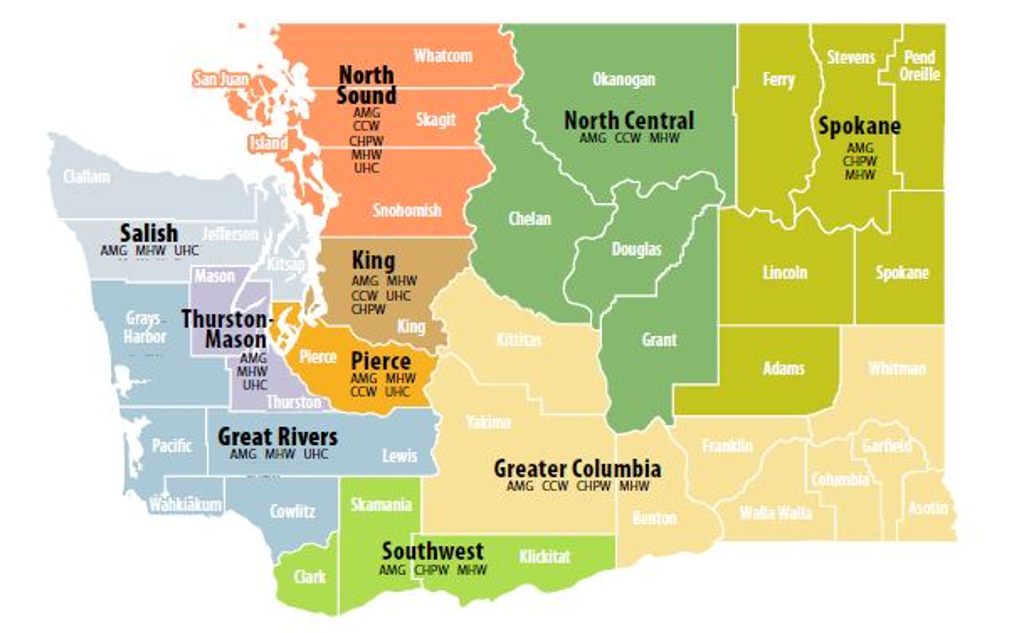
The map above shows all of the different Administrative Services Organizations (BH-ASO) of Washington. Each BH-ASO State Resource contracts with a variety of groups and organizations and the Health Care Authority to provide particular services for their area.
Great Rivers BHASO
Serving Cowlitz, Grays Harbor, Lewis, Pacific, and Wahkiakum counties
- Contact: Kari Goudge
- Phone: 503-680-6625
- Email: kgoudge@grbhaso.org
- Address: PO BOX 201, Chehalis, WA 98532
Greater Columbia BHASO
Serving Asotin, Benton, Columbia, Franklin, Garfield, Kittitas, Walla Walla, Whitman and Yakima Counties
- Contact: Sindi Saunders
- Phone: 509-737-2442
- Email: sindis@gcbh.org
- Address: 101 N. Edison, Kennewick, WA 99336
King BHASO
Serving King County
- Contact: Sandy Tomlin
- Phone: 206-263-8957
- Email: sandy.tomlin@kingcounty.gov
- Address: 401 5th Ave. Suite #400, Seattle, WA 98104
- Fax: 206-205-1634
North Central Washington BHASO
Serving Chelan, Douglas, Grant and Okanogan County
- Contact: Gerardo Perez-Guerrero
- Phone: 509-423-6842
- Email: gerardo.perez-guerrero@beachonhealthoptions.com
North Sound BHASO
Serving Island, San Juan, Skagit, Snohomish and Whatcom County
- Contact: Angela Fraser-Powell
- Phone: 360-416-7013 ext. 646
- Email: angela_fraser-powell@nsbhaso.org
- Address: 301 Valley Mall Way, Suite 110, Mt. Vernon, WA 98273
- Fax: 360-416-7017
Pierce County BHASO
Serving Pierce County
- Contact: Kris Schadegg
- Phone: 775-276-0507
- Email: Kristen.schadegg@beaconhealthoptions.com
- Address: Beacon Health Options, 10116 36th AVe Ct, SW, Lakewood, WA 98499
Salish
Serving Kitsap, Clallam and Jefferson County
- Contact: Martiann Lewis
- Phone: 360-307-4275
- Email: mlewis@co.kitsap.wa.us
- Address: 614 Division Street, MS-23, Port Orchard, WA 98366
Southwest Washington
Serving Clark, Klickitat and Skamania County
- Contact: Kirstin Peterson
- Phone: 360-216-3020
- Email: Kirstin.peterson@beaconhealthoptions.com
- Address: 1220 Main St, 4th Floor, Vancouver, WA 98660
Spokane County BHASO
Serving Spokane County and Spokane Northeast Counties: Adams, Ferry, Lincoln, Pend Oreille, and Stevens
- Contact: Josh Henderson
- Phone: 509-477-4492
- Email: jhenderson@spokanecounty.org
- Address: 312 W. 8th Ave,Spokane, WA 99204
Thurston / Mason BHASO
Serving Thurston and Mason County
- Contact: Gary Enns
- Phone: 360-763-5789
- Email: gary.enns@tmbho.org
- Address: 612 Woodland Square Loop, Suite 401, Lacey, WA 98503
Family Youth System Partner Round Table (FYSPRT)
Washington State Family Youth System Partner Round Tables (FYSPRTs) provides a forum for families, youth, systems, and communities to strengthen sustainable resources by providing community-based approaches to address the individual behavioral health needs of children, youth, and families.
Learn More
The Washington Administration Codes (WACs) for Parents of Special Needs Children
The WACs are the regulations of executive branch agencies as issued by the authority of statutes. Like legislation and the Constitution, regulations are a source of primary law in Washington State. The WAC codifies the regulations and arranges them by subject or agency. The online version of the WACs is updated twice a month.
This state resource shortlist shows the WACs by title, and currently, the WAC titles number from 1 to 468, and under each title, they are further broken down by chapter. These chapters are then broken down into smaller and smaller subsections and headings, for easier navigation and research. Printed versions are updated twice a year, and as mentioned above, the online version is updated twice a month.
So, if you happen to see a printed WAC related to the topic you are researching, be sure to check it against the online version, just to make sure you have the latest version of the applicable WAC.
If you don’t see what you are looking for, please
view all of the current WACs
and use the website search feature for assistance. If you are still having trouble, you can always
contact us
and we will help in any way we can.
- General
- Child Support
- Child Protective Services
- Foster Care/Adoption/Reconciliation
- Domestic Violence
- Aging and Adult Services
- Child Care Agencies/Licensing Requirements
- Assistance Programs
- WAC Chapter 392-173 – Special Education Programs
- WAC Chapter 388-14A – Division of Child Support Rules
- Title 67 – Department of Services for the Blind
- Title 72 – Washington State School for the Blind
- Medical Assistance
- Juvenile Rehabilitation
- Alcohol and Substance Abuse
- Problem Gambling
- Deaf and Hard of Hearing Services
- Developmental Disability Services
- Mental Health
- Special Commitment Center
- Vocational Rehabilitation
- WAC Chapter 392-173 – Special Education Programs
- WAC Chapter 388-14A – Division of Child Support Rules
- Title 67 – Department of Services for the Blind
- Title 72 – Washington State School for the Blind
DSHS State Resources and Programs to Assist You
DSHS – Children’s Administration, Washington State
– Children’s Administration staff in 44 field offices work with children and families to identify their needs and develop a plan for services that support families and assure safety and well-being for children. These services are designed to reduce the risk of abuse, prevent out-of-home placement, and assure safety and permanency for children in care. In many instances, the Children’s Administration can provide referrals to local services in your community. One of the best DSHS resources.
DSHS Finding State and Federal Benefits
– With this DSHS resource, you can find and apply for additional benefits and assistance for your child’s or family’s needs. Again, the services do vary slightly from one area to another.
Washington Prescription Drug Program
– The Prescription Drug Program has developed several tools, released discount card programs, and pooled resources with other organizations with the same goal in mind… providing information and programs that serve the residents of Washington and their current needs for prescription drug purchasing assistance. This is a great DSHS resource to utilize.
Children’s Long Term Inpatient Program (CLIP)
– The CLIP Administration is responsible for policy and clinical decision making regarding admission to Washington state’s five CLIP Programs. The CLIP Administration is also the statutory placement authority for adolescents involuntarily committed for up to 180 days of inpatient care. The CLIP Administration assists the Mental Health Division of the Department of Social and Health Services (DSHS/MHD) with monitoring the care provided by the CLIP Programs.
Kinship Care in Washington State
– Are you a grandparent or other family member raising a relative’s child? You are not alone. Over 35,000 people in Washington State are caring for a relative’s child. The financial, legal, and emotional issues of raising a relative’s child can be challenging. Services and support when raising a relative’s child can be a lifesaver. Getting answers to questions and finding services, programs, and support can be confusing and overwhelming.
Department of Children, Youth, and Families
- DCYF is the lead agency for state-funded services that support children and families to build resilience and health to improve educational outcomes. They accomplish this by partnering with state and local agencies, tribes and other organizations in communities across the state of Washington. Their focus is to support children and families at their most vulnerable points, giving them the tools they need to succeed.
Kinship Care State Resources
Kinship Care is a term used to identify people who are raising family members, other than their own children.
And since we welcome all male caregivers of children with emotional, behavioral, and mental health concerns, we felt it was important to inform you of this service, which is provided by
DSHS.
Normally this term is associated with grandparents who are raising their grandchildren, due to a variety of circumstances. But, if you are an aunt or uncle, a cousin, or sibling, raising a dependent child, you meet the criteria, as well. Over 35,000 people in Washington State are caring for a relative’s child.
The financial, legal, and emotional issues of raising a relative’s child can be challenging. Services and support when raising a relative’s child can be a lifesaver. It is for that reason that we have assembled this list of resources.
Here are a few facts regarding this situation in Washington state…
- There are 61,905 children living in grandparent-headed households (4.1% of all the children in the state).
- There are another 24,086 children living in households headed by other relatives (1.6% of all the children in the state).
- Of the children living in households headed by grandparents or other relatives in Washington, 35,761 are living there without either parent present.
- 35,341 grandparents report they are responsible for their grandchildren living with them (7,903 in King County and 5,364 in Pierce County): 6% of these grandparents are African American; 10% are Hispanic/Latino; 5% are American Indian or Native Alaskan; and 48% are White.
- 39% of these grandparents live in households without the parents present. 71% are under the age of 60; 13% live in poverty.
So, there is no reason to feel alone in your situation. There are thousands of folks in Washington, in a situation like yours. And, there are numerous resources available to assist you.
Youth Supports
- Friends of Youth – Serves King County homeless youth - https://www.friendsofyouth.org/homelessServices.aspx
- Safe Place - http://friendsofyouth.org/safeplace.aspx
- GED Prep Classes - http://friendsofyouth.org/GED.aspx
- Youth Care – Serves King County - http://www.youthcare.org/
- Community Passages - Seattle-based nonprofit; zero youth incarceration - http://www.communitypassageways.org/
- Choose 180 – Serves King County http://www.choose180.org/program-overview
- The Healthy Transitions Project – Helping youth and young adults with serious mental disorders - https://www.hca.wa.gov/assets/program/health-transitions-project.pdf
- Oasis Youth Center - Tacoma - https://devoasis.dreamhosters.com/
- Fab-5-Tacoma - https://www.fab-5.org/
- Team Child - https://teamchild.org/